

My mother chose not to tell me for years. I think I was in junior high when she finally solved the mystery for me by telling me a story from my babyhood. She described how a loud noise nearby—the source of the noise was lost to her—startled me so badly that I cried. In her version, I screamed and wailed, and I was inconsolable. I reacted to loud noises in exactly the same way throughout my infancy and toddler years. I had a sensitivity to loud noises, especially sudden ones close to me.
As I matured into adulthood, I learned to deal with most loud noises like thunder cracks, sirens, high winds, etc. But I’ve never been OK with them, never been comfortable hearing them. Often react with shaking anxiety. The one noise I’ve not been able to conquer? Fire or smoke detector alarms.
I’ve lived in the same apartment for over 40 years, so I’ve seen a lot in the building. After the current owner’s husband bought the building, the fire department inspected it. They required that the owner install a fire alarm system—minus sprinklers—in the building. Two or three sensor/smoke detectors were installed high on the walls of each floor’s public hallway. Several months later, we had a big thunderstorm with high winds that triggered the building fire alarm. The caretaker turned it off, but inspected for smoke just in case. For years with that fire alarm system, every time we had high winds from a certain direction, the alarm went off. Since the box that emitted the alarm—it sounded like a cross between a fog horn and siren—was right outside my apartment door. The sound produced an anxiety attack for me with shaking, sweating, the fight or flight reflex, and a desire to scream.
Eventually, someone at the fire alarm company pinpointed which sensors were the problem and replaced them. But for me, the damage had been done. I was now programmed to respond with an anxiety attack whenever the building fire alarm went off.

One Sunday about 20 years ago, I was enjoying a quiet and relaxing afternoon when the building fire alarm went off. The sound launched me out of my seat. I grabbed my keys and went out to check for smoke. The caretakers had taught me how to turn off the alarm if they weren’t around. Checking the alarm panel in the front foyer, only one light was on for the ground floor. I could smell smoke. Residents began leaving their apartments. The ground floor hallway was completely filled with smoke. I couldn’t turn off the alarm until I knew it was safe to do so, and that meant finding the source of the smoke. Turned out to be an apartment where a guy who’d just gotten home from his work shift had put something on the stove then gone into the bathroom to wash up. In that short time, smoke began to fill the apartment from the kitchen. He made the mistake of opening his apartment door, freeing the smoke to enter the public hallway. But there was no fire. I checked the kitchen after the guy told me what happened. It took a long time to air out the hallway so I could turn off the alarm—at least it felt like a long time. In the years since, we’ve had a couple more kitchen “fires” and one laundry room mishap that set off the building fire alarm. With new building managers, no resident is allowed to turn off the building fire alarm. Instead, we must call the fire department.
Last year, I experienced my own kitchen mishap—not a fire, but a smoke event that set off my smoke detector. That piercing tone felt like it was boring into my head through my ears. I stopped the smoke at the source, but it took a while to air out my apartment. That’s when I discovered I probably need a new kitchen vent fan. I set up a couple fans aimed at my open windows. I did not open my apartment door. It’s astonishing how quickly these smoke events can happen—within minutes.
A couple months ago, my hallway smoke detector began its annoying beeping to let me know it was dying. I notified building management. I figured out how to silence the beeping until they could replace the smoke detector. The manager installed a new one in the hallway, connected to the building electrical, and a new one in my bedroom on batteries, about 8 feet from the hallway detector. The manager told me the hallway detector was so sensitive, I needed to put a dust cover on it when I did my cleaning. I figured I wouldn’t need to think about them for at least a year.
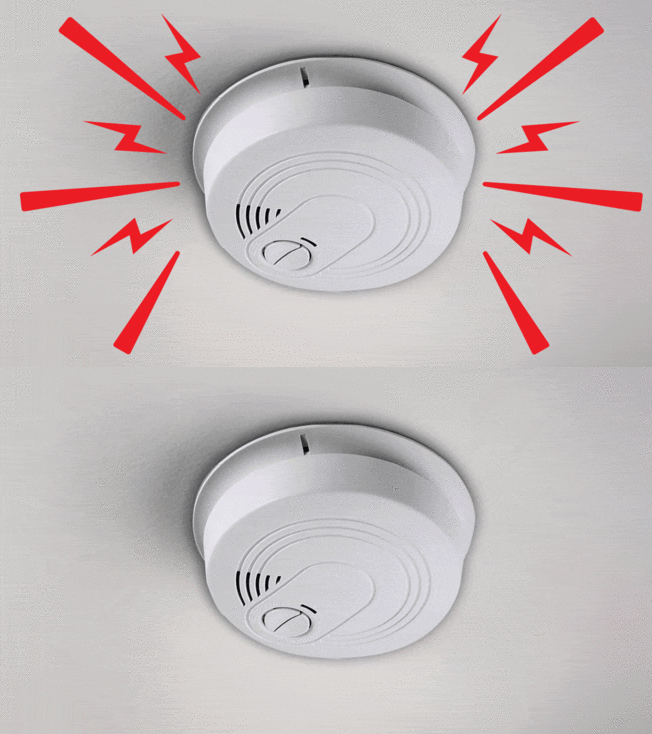
So last week, when one started beeping as if it were dying, I was shocked and annoyed. I can’t stand the loud, piercing. But the hallway detector’s light was green so it wasn’t dying. It took me several minutes—after I’d emailed building management about it--to realize it was the bedroom detector. And it was. I removed it from the wall and pulled out one battery, a cheap manufacturer’s battery, no wonder it hadn’t lasted long. When the building manager showed up at my door, as surprised as I’d been, I told him about the cheap batteries. Lesson: never use the manufacturer’s batteries.
I was still shaking when the building manager stopped by. The dying smoke detector with its obnoxious, piercing beeps had triggered an anxiety attack. Sweat soaked my face and neck and I needed to sit down to catch my breath. I’ve made some progress, though. I no longer descend into a mental fog when the attack starts, so I’m able to identify the source and what I need to do to stop the loud noise. My body, however, still reacts in anxiety mode.
Loud noises, depending on the source, are probably annoying for everyone—the car without a muffler going by, the jack hammer breaking up cement on a city street, a car alarm at 2 a.m. Reacting with anxiety means my anxiety is due to a sensory sensitivity. Compared to people, especially children, with sensitivities to multiple stimuli, mine is probably mild. But I still have to deal with the loud noise plus the anxiety. Is it no surprise then that I do my best to avoid loud noises?

Friendly Reminder: the paperback of my first novel, Perceval’s Secret, is on sale now at Amazon, B&N, Bookshop.org/shop/ccyager, and IngramSpark.
The ebook of Perceval’s Shadow is on sale now at Amazon and B&N; and the paperback is on sale at Amazon, B&N, Bookshop.org, and IngramSpark.